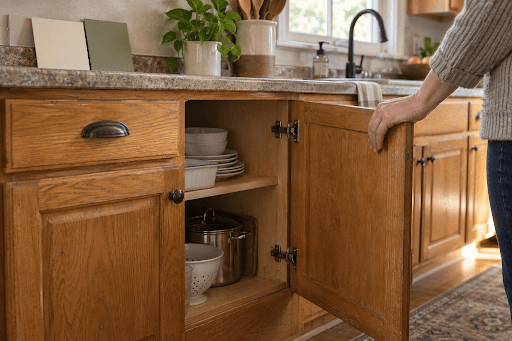
If your Nashville kitchen feels dated but the cabinets still function well, you may be wondering whether you should repaint them or replace them entirely. Both options can dramatically change the appearance of a kitchen, but they solve different problems.
Cabinet painting may be a practical option when you’re satisfied with the existing layout, storage, and construction but want a different color or a refreshed finish. Replacement may make more sense when cabinets are structurally damaged, poorly constructed, or no longer meet the way your household uses the kitchen.
At Pointer Painting, formerly Davis Custom Finishes, we help Nashville homeowners evaluate the condition of their cabinetry, existing finish, and project goals before deciding whether cabinet painting is an appropriate choice.
Start With the Condition of Your Existing Cabinets
Before choosing colors or comparing finishes, inspect the cabinets themselves.
Look beyond surface scratches or an outdated stain. You want to understand whether the cabinet boxes, doors, drawer fronts, and other components provide a sound foundation for refinishing.
Pay particular attention to:
- Cabinet boxes
- Doors and drawer fronts
- Areas around sinks and dishwashers
- Shelves and interior components
- Hinges and hardware
- Previous repairs
- Peeling or failing finishes
- Swollen or deteriorated material
- Water-damaged areas
Cosmetic wear and structural deterioration are different problems.
If the cabinetry is generally sound and you’re happy with its function, painting may deserve consideration. If the underlying material is failing, those problems need to be addressed before choosing a new finish.
When Cabinet Painting Is a Strong Option
Painting can be a good fit when the primary problem is appearance rather than function.
Perhaps you like the kitchen layout and have enough storage, but the existing cabinet color makes the room feel dated. Maybe the finish has become worn, or you’re replacing countertops and want the cabinetry to coordinate with the new materials.
Painting can allow you to keep the existing cabinet system while changing a significant visual element of the room.
It may be worth considering when:
- The cabinet boxes remain structurally sound.
- You like the existing kitchen layout.
- Storage works for your household.
- Door and drawer styles still suit the room.
- The primary concern is color or finish.
- The surfaces can be appropriately prepared for a new coating.
An evaluation of the actual cabinetry can help determine whether refinishing is practical before you invest time choosing colors.
When Replacement May Make More Sense
Painting isn’t intended to solve every cabinet problem.
If you’re frustrated because the kitchen doesn’t provide enough storage, cabinets are positioned poorly, or the layout no longer works for your household, changing the finish won’t correct those concerns.
Replacement may deserve consideration when you’re dealing with significant issues such as:
- Severely damaged cabinet boxes
- Swollen or failing material
- Substantial water damage
- A layout that doesn’t function well
- Storage that no longer meets your needs
- Structural problems that cannot reasonably be addressed through preparation
Don’t let an attractive new coating distract from problems underneath it.
Paint is a finish. It isn’t a substitute for sound cabinetry.
Look Carefully Around Sinks and Dishwashers
Some areas of a kitchen deserve particularly close inspection before cabinet painting.
Cabinetry around sinks, dishwashers, and other areas exposed to moisture can develop deterioration that isn’t immediately obvious from across the room.
Look for swelling, damaged edges, loose material, discoloration, or other changes.
If you notice recurring moisture or water damage, the source should be addressed before refinishing.
A coating can improve an appropriately prepared cabinet surface, but it shouldn’t be used to conceal an unresolved moisture problem.
Why Cabinet Preparation Is Different From Wall Preparation
Cabinet painting shouldn’t be approached like repainting an ordinary interior wall.
Kitchen cabinets are frequently touched and exposed to cooking residue, oils, fingerprints, cleaners, spills, and other contaminants.
That makes preparation especially important.
Depending on the existing cabinetry and coating system, preparation may involve:
- Cleaning and degreasing
- Removing hardware
- Labeling doors and drawers
- Addressing appropriate surface defects
- Sanding or deglossing
- Preparing previous finishes
- Applying a compatible bonding primer where appropriate
- Using a coating system intended for the surface and expected use
The exact process should reflect the material, existing finish, and coating selected for the project.
Simply applying new paint over an inadequately prepared surface can leave adhesion problems underneath an otherwise attractive color.
Ask How Doors and Drawers Will Be Handled
Cabinet doors and drawer fronts represent a significant portion of what you see and touch every day.
Before work begins, ask how these components will be prepared, coated, dried, and reinstalled.
You should understand whether hardware will be removed, how pieces will be identified, and what the expected sequence of work will be.
This is also a good time to discuss existing damage.
A small surface imperfection may be addressed as part of preparation, while more substantial damage may require another solution.
Defining those conditions during the estimate can help establish a clearer scope.
Choose a Coating for Cabinet Use
Color isn’t the only product decision.
Cabinet surfaces receive frequent handling, so the proposed coating system should be selected with that use in mind.
Ask about:
- Surface compatibility
- Preparation requirements
- Primer where applicable
- Finish appearance
- Cleaning guidance
- Drying requirements
- Cure time
- Normal-use restrictions after installation
Don’t assume that choosing a higher sheen automatically makes an ordinary wall paint suitable for cabinetry.
The complete coating system matters.
Think About Cure Time, Not Just Dry Time
This is one of the most important distinctions when planning cabinet painting.
A coating may feel dry to the touch before it has developed the hardness associated with further curing.
That matters because cabinets are handled constantly.
Doors are opened and closed. Drawers are pulled. Knobs and handles are touched repeatedly. Kitchen surfaces are also exposed to cleaning and everyday activity.
Before the project is completed, ask when:
- Doors and drawers can be reinstalled
- Cabinets can return to normal use
- Surfaces can be cleaned
- Hardware can be handled normally
- The coating is expected to reach its applicable cure stage
Follow the instructions provided for the particular coating system rather than assuming dry-to-touch means ready for unrestricted use.
Plan How You’ll Use the Kitchen During the Project
Cabinet painting can affect normal kitchen access.
Before work starts, discuss which areas need to remain available and what belongings should be removed from cabinets or counters.
Consider:
- Cooking access
- Refrigerator access
- Sink use
- Food storage
- Countertop access
- Pets and children
- Ventilation
- Door and drawer removal
- Drying and curing areas
Knowing what to expect can make the project easier to plan around.
If portions of the kitchen will be temporarily unavailable, determine what your household will need before the project begins.
Cabinet Color Can Change the Entire Room
Cabinets occupy a large amount of visual space, so changing their color can significantly alter the appearance of a kitchen.
Don’t choose the cabinet color in isolation.
Compare it with:
- Countertops
- Backsplash
- Flooring
- Wall color
- Trim
- Appliances
- Hardware
- Nearby furniture
- Adjoining rooms
White isn’t the only option.
Depending on your kitchen, soft neutrals, muted greens, warm grays, deeper colors, and other selections may work with the materials already present.
The goal isn’t simply to choose a popular cabinet color. It’s to find one that works with your particular room.
Evaluate Samples in Your Kitchen’s Actual Light
Nashville homes can have very different interior lighting conditions.
A kitchen with several large windows may make a cabinet color appear very different from a kitchen receiving limited natural light.
View samples in the actual space.
Check them in:
- Morning light
- Afternoon daylight
- Shaded areas
- Under-cabinet lighting
- Overhead lighting
- Evening light
Also compare the color vertically against the existing cabinet surfaces when practical rather than evaluating it only on a sample lying flat on a countertop.
Colors and undertones can shift as lighting changes throughout the day.
Consider a Two-Tone Cabinet Design
If you want more contrast without using a dramatic color throughout the entire kitchen, a two-tone approach may be worth considering.
For example, homeowners may choose one color for perimeter cabinets and another for an island.
Whether that works in your kitchen depends on the layout, materials, lighting, and colors already present.
The two selections should be evaluated together with countertops, flooring, backsplash, and surrounding wall colors.
The goal should be an intentional relationship rather than two colors chosen independently.
Think About Hardware at the Same Time
Existing knobs, pulls, and hinges can influence how the newly painted cabinetry looks.
You may decide the current hardware works well with the new finish, or you may want to update it as part of the larger kitchen refresh.
If you’re changing hardware size or placement, discuss that before preparation begins.
Existing holes, new locations, and other modifications can affect the surface work required.
Planning those details early can prevent unnecessary changes after the finish has already been applied.
Compare Painting and Replacement Based on Your Actual Goals
The decision shouldn’t simply come down to which option has the lower initial price.
Ask what you’re trying to accomplish.
If your goals are primarily:
- Changing cabinet color
- Refreshing a worn finish
- Coordinating cabinetry with other kitchen updates
- Preserving a layout that already works
then cabinet painting may deserve consideration.
If your goals involve:
- Changing the kitchen layout
- Adding substantial storage
- Replacing failing cabinetry
- Correcting structural problems
- Changing cabinet configuration
then replacement may better address the underlying objective.
Understanding the difference can prevent you from investing in a cosmetic update when what you actually want is a functional redesign.
Frequently Asked Questions
Is cabinet painting cheaper than replacing cabinets?
It can be, particularly when the existing cabinetry is structurally sound and the layout is staying the same. The actual comparison depends on cabinet condition, number of doors and drawers, preparation, coating system, repairs, and what would be involved in replacement.
Can every type of cabinet be painted?
No. The cabinet material, existing finish, condition, and compatibility with the proposed coating system need to be evaluated. Severe water damage, failing surfaces, or structural deterioration may require repair or replacement instead.
How long before painted cabinets can be cleaned normally?
That depends on the particular coating and curing conditions. A surface may feel dry before it’s ready for routine cleaning or heavy handling. Follow the project-specific care instructions for the selected coating.
Do cabinet doors have to be removed for painting?
The process depends on the project and coating system. Ask during your estimate how doors, drawer fronts, hardware, cabinet frames, and other components will be handled so you understand the proposed workflow.
Can I change the hardware when my cabinets are painted?
Yes, hardware changes can be discussed as part of the project. If new hardware uses different hole spacing or placement, identify that before preparation and finishing so any necessary surface work can be considered in the scope.
Decide Whether Cabinet Painting Fits Your Nashville Kitchen
Cabinet painting can create a substantial visual change without replacing an entire cabinet system, but it’s most useful when the cabinetry underneath the finish remains suitable for continued use.
Start with the structure. Evaluate doors, drawers, boxes, areas exposed to moisture, existing coatings, and the layout itself. Then consider preparation, coating selection, color, hardware, kitchen access, drying, and curing.
If the cabinets are sound and you’re primarily looking for an updated appearance, painting may provide the change you’re after. If the cabinetry is deteriorated or the layout no longer works, replacement may deserve a closer look.
If your Nashville kitchen needs an updated look, request an estimate from Pointer Painting, formerly Davis Custom Finishes. We’ll review the cabinetry, discuss your goals, and help you understand the preparation, finish options, project scope, and curing considerations before you decide on the next step.


